ASSESSMENT OF COLLECTIBLE DESIGN
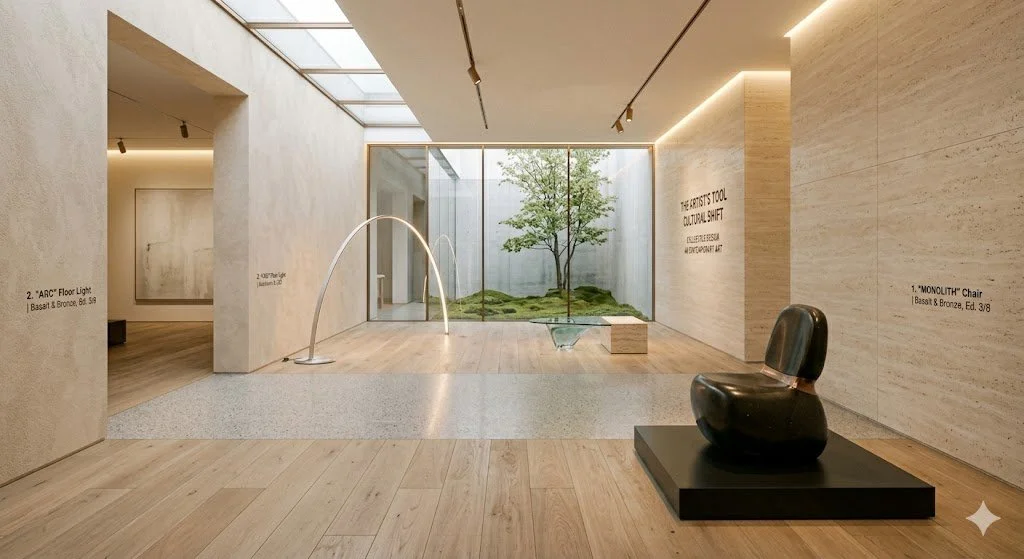
The 2026 Art Market Report by Art Basel and UBS , shaped by Dr. Clare McAndrew 's ongoing research at Arts Economics, offers an interesting point of entry. Among its findings, a particularity surfaces among traditional market participants: a drift in collector interest toward design, decorative works, and collectibles, one could say, design as a collectible...
The market data suggests a direction. According to ArtTactic, the collectible design category grew 20.4 percent in the first half of 2025, reaching $172 million compared to $143 million the previous year, design objects and collectibles continue to expand points toward something more durable than a trend.
This raises a fundamental question: whether, and how, a design object can be classified as "collectible" in the same vein as fine art - and where exactly the line falls between a functional item and a collectible specimen.
Sophie Pearce, founder and director of Béton Brut, addressed this at a MAISON&OBJET panel on collectible design. Her framing centered on authorship as the organizing concept: the object as carrier of a designer's sustained intellectual position, embedded in the history of their practice and charged with relevance to a broader cultural moment. What she described as the object's aura - its atmosphere - operates at two registers simultaneously: within the arc of a specific designer's work, and within the aesthetic and ideological conditions of its time. Beyond that, she pointed to the quality of material realization, the coherence between idea and execution, the presence of genuine reinvention, and, crucially, cultural resonance in the present.
A panel at Design Miami explored similar ground, and the responses were comparably plural. One curator framed collectibility as essentially image - dependent - a subjective register of resonance, of objects that enter into dialogue with the past rather than merely repeating it. Others on the panel emphasized the thought process behind an object's making, its capacity to be genuinely different, and a cluster of qualities that recur across conversations in this space: scarcity, material integrity, innovation of thought, a strong artistic concept, and relevance to the culture in which it appears.
One might see, these criteria cannot deliver a formula for a proper "design quality assessment".
Clare McAndrew, „The Art Basel and UBS Survey of Global Collecting 2026", 12. März 2026, Art Basel & UBS, artbasel.com
Record Prices, New Buyers and Global Reach: Design's Moment Has Arrived, Observer, 21. August 2025, observer.com.
Design Miami, Collecting Design Contemporary Perspectives, YouTube.com
MAISON&OBJET, Shaping the extraordinary : the art of collectible design today - Maison&Objet Paris – The Talks, YouTube.com
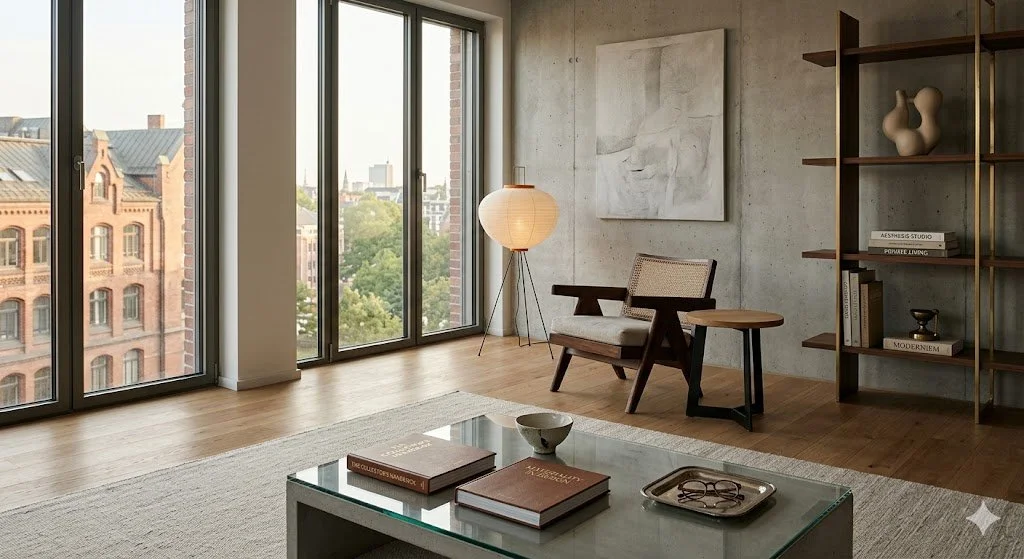
The Question of the Boundary
Somewhere inside this discussion sits the question, one that the field has circled without quite settling: where does design end and art begin, and does the distinction still do a meaningful work?
The answer, on reflection, may lie less in the object than in the orientation of the person making it. A designer operating within a clear brief, serving an industry's functional and commercial requirements, occupies a different position from a designer who uses material, function, and form as the primary vocabulary of an independent inquiry. The latter's relationship to their practice is structurally closer to that of an artist - the dependence is not on a client or a sector, but on the internal logic of an evolving body of work. What appears to matter, in the objects that generate the most sustained collector attention, is a state of mind that prioritizes position over commission.
Maarten Baas's Where There's Smoke series makes the point. The act of burning - destruction as method - is not a technique deployed in service of an object. It is the object's meaning. The functional result, a charred but intact chair or cabinet, exists to make that proposition legible in domestic space. It is a sustained argument about permanence and damage, given a form that one can sit in.
https://maartenbaas.com/products/where-there-s-smoke-1
The same could be said of a Sabine Marcelis resin volume - a proposition about light and material perception - or of a piece by the Campana Brothers, where the ethnographic and formal registers are inseparable. These objects organize space intellectually, which is to say they do what a serious artwork does, while also inhabiting the physical and spatial logic of a life.

A Shift in the Aesthetic Frame.
Publications like Architectural Digest and Wallpaper* have, for sure, played a particular role in making this legible at scale. What these platforms have shifted, over the past decade, is the basic unit of aesthetic representation: the collector's home is no longer shown as a neutral backdrop for individual works, but as a highly curated spatial ecosystem in which art, design, and architecture form a unified body of value.
This reframing has consequences for how collectors think, and for what they are willing to consider as acquisition. Kimberly Sørensen, Phillips' design specialist, notes that younger collectors are increasingly present in this market - Millennials and Gen Z now represent approximately 20 percent of design bidders at the house. Many, she observes, are drawn partly by the sustainability logic of the secondary market, and partly by the accessibility that social media platforms have opened: the ability to encounter designers across periods and geographies in ways that circumvent traditional gallery hierarchies.
Whether this demographic shift represents a deepening of the market or a broadening of it - whether it produces more serious collectors or simply more buyers - is a question worth holding open...
Record Prices, New Buyers and Global Reach: Design's Moment Has Arrived, Observer, 21. August 2025, observer.com.
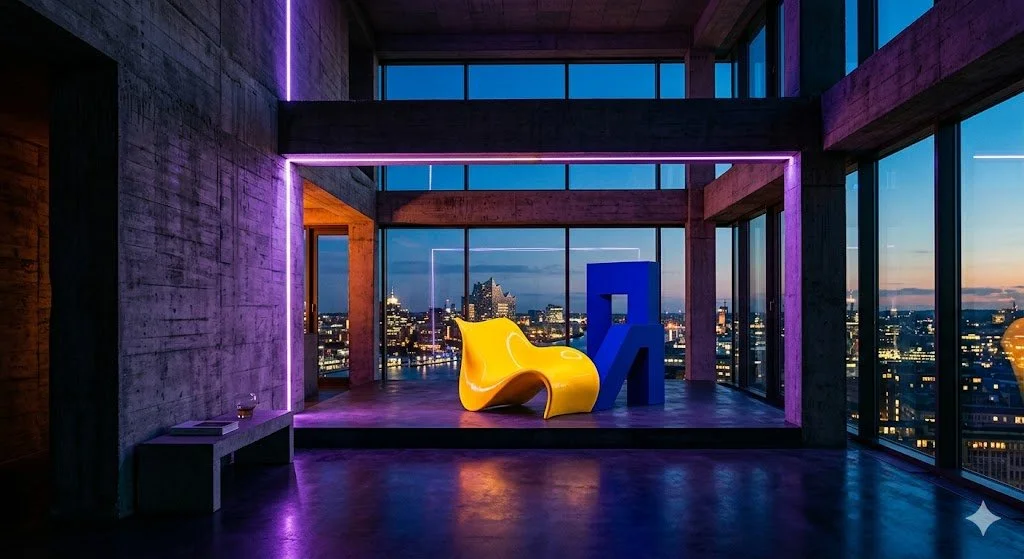
Inhabited Assets: Redefining Value through the Lens of Gen Z and Millennials.
For a collector prepared to engage with this territory at a serious level of resolution, the acquisition logic changes and the relevant unit of thought shifts from the individual object to the curated environment. Where a Studio Formafantasma table, a Ronan Bouroullec textile, and a Lucio Fontana edition share and create a sustained intellectual argument.
https://formafantasma.com
https://www.bouroullec.com
The financial dimension of this is still being established, which is part of what makes the territory interesting. Secondary market activity at Phillips, Wright Auction House , and Sotheby's Design sales has been substantive, and there is growing evidence that well-curated interiors contribute to transaction values in the upper segments of the luxury real estate market and the current surge in the collectible design market can hardly be understood without the radical shift in perspective brought by Millennials and Gen Z, who have reimagined the concept of collecting from a static investment into a performative way of life. For these generations, the object is no longer a mere trophy on a wall, but an integral part of a "curated self". Driven by skepticism toward mass-produced insignificance and a heightened awareness of the ecological footprint of consumption, they seek objects that take an intellectual position and possess a structural integrity designed to endure for decades.
In this context, social platforms act a as global marketplaces of aesthetics where the boundary between private living space and public gallery blurs. This synthesis of digital connectivity, a longing for authentic materiality, and a refusal to see design as a mere service gives the design market its unprecedented dynamism today.
A Field in Formation
Fine art developed its critical apparatus over centuries. Collectible Design is constructing its own now. This creates genuine navigational complexity, and it would be misleading to suggest otherwise. The markers that orient a buyer in more established markets are less stable here. Taste and argument carry more weight than institutional consensus, because institutional consensus has not fully arrived.
What this field rewards, above all, is the capacity to make distinctions - to perceive differences that are not yet widely legible and to understand why they matter. That capacity has always been the core of connoisseurship. Collectible Design extends its application into every spatial and material dimension of a life lived with objects.
Whether the market will price that fully - and when - remains an open question. But the direction of travel seems clear enough to warrant asking it now.
AUTHOR
Victor Justus Messerschmidt
PERSONS MENTIONED
Dr. Clare McAndrew , Kimberly Sørensen , Sophie Pearce, Joris Laarman , Faye Toogood, Sabine Marcelis , Maarten Baas, Ronan Bouroullec, Lucio Fontana, Magnus Resch, Humberto Campana, Fernando Campana, Nikolai Haas, Simon Haas, Andrea Trimarchi, Simone Farresin.
Visuals created with Google Gemini.
