THE STUDIO. VOL. 1/26. “ARCHITECTURAL RESONANCE”
LEVEL 01: A PLEA FOR RANGE & RESONANCE
„Resonance“
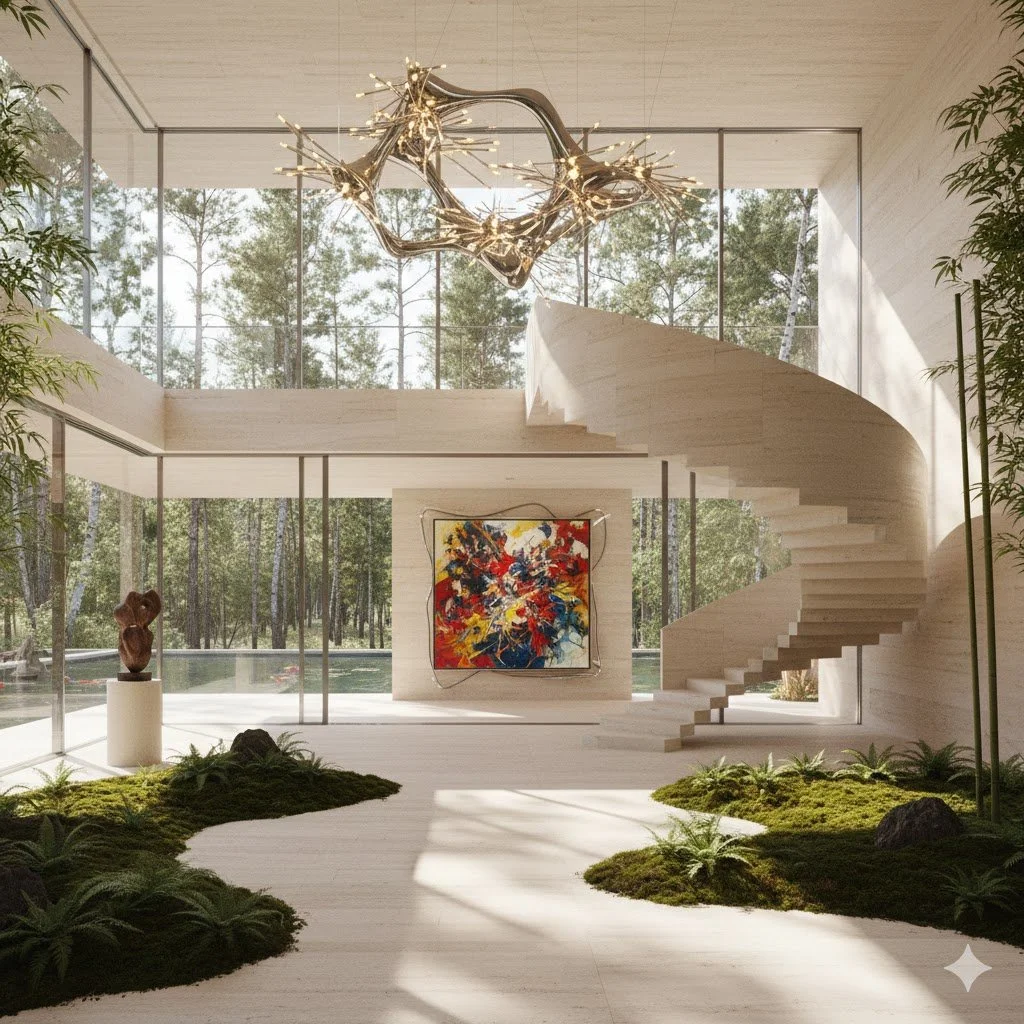
It is the interplay of architectural space, light, and material that is capable of generating the particular aesthetic relevance of art - and thus a „resonance“ of a collection. For this reason, THE STUDIO consciously includes architecture as the supporting structure of a collection in its articles.
Before subsequent entries turn their focus toward current market events and their individual philosophical discourses, these first articles you are reading serve to sharpen the general vision of Æsthesis Studio: to contemporarily bridge aesthetic experience of viewing art with the economic logic of the art market.
David Epstein
My aim is to revive art collecting with a modern sense of vitality; to not merely manage a collection, but to conceive it as a living ecosystem. Inspired by David Epstein’s concept of "Range" - the ability to connect a vast spectrum of perspectives - I see interdisciplinarity as a possibility to a deeper sovereignty. For the collector, this implies a conscious endeavor: moving away from the isolated art object, toward a holistic culture of collecting that views architecture and design as enriching components. This path demands greater intellectual effort, yet rewards the collector with a quality of resonance that transcends mere material value. An increased intellectual investment, which can evolve into an investment in one’s own aesthetic sovereignty.
Frank Gehry
Institutions such as Frank Gehry’s Fondation Louis Vuitton or Renzo Piano’s Fondation Beyeler function as world-renowned examples for architectural force fields, proving that architecture does not want to dictate answers; instead, wanting to prepare the stage for continuous intellectual stimulation as resonance chambers. It is also an example for styles seemingly contradicting or accidentally colliding each other; where proper synthetical energy is released and is able to transform a collection from a mere inventory list into a living "Gesamtkunstwerk".

LEVEL 02: "GESAMTKUNSTWERK"
Friedrich Schlegel
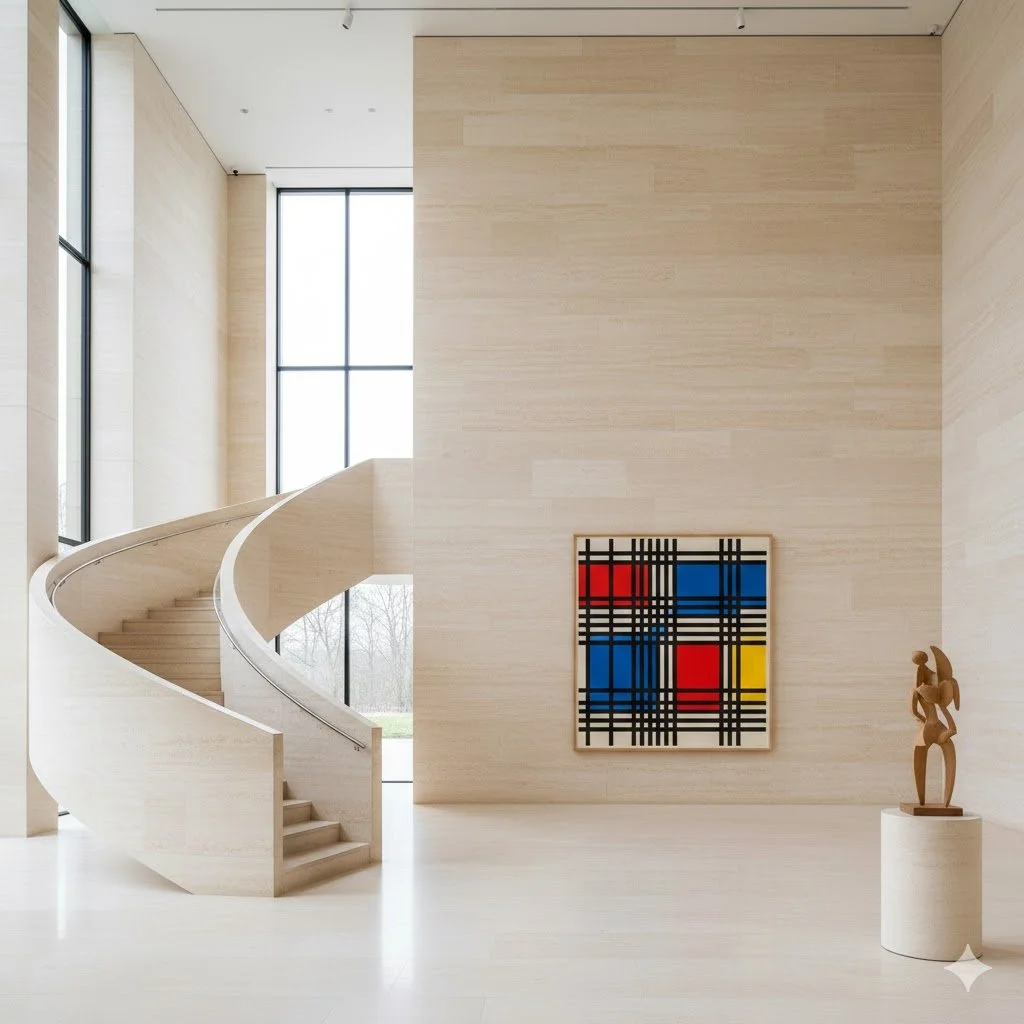
Thinking in terms of the "Gesamtkunstwerk" (total work of art) is a return to a long tradition: from Friedrich Schlegel’s Early Romantic writings to Richard Wagner’s vision of uniting architecture, sculpture, and painting in his essay “The Artwork of the Future”. However, the radical turning point occurred in the summer of 1923 in Weimar: the Bauhaus exhibition proclaimed that a chair, a painting, and the protective concrete shell form an inseparable field of experience.
Pieter Oud
The program of that historic week was a manifesto of this synergy: Kandinsky’s plea for "synthetic art" merged with Pieter Oud’s new understanding of space, while the mechanical ballets of Oskar Schlemmer and Kurt Schmidt geometrically reordered the human figure within the room. The finale was a synesthetic explosion of Ludwig Hirschfeld-Mack’s "Reflected Light Compositions" - an architectural, musical, and cross-genre performance proving that resonance knows no borders.
LEVEL 03: THE SOVEREIGNTY OF RANGE
David Epstein
Collecting can be described as a form of world-building - a framework of relationships in which works, spaces, and decisions enter into a permanent dialogue. To keep this system vital, one must resist the comfort of the "specialist silo". As David Epstein demonstrates: in "wicked" environments like the art market - that complex fusion of emotion, capital, and history - it is not only the experts, but also the generalists who can maintain their orientation. Their advantage lies in an instinct honed through interdisciplinary observation and a foresight that does not read developments in isolation, but rather in context.
Norman Foster
Norman Foster’s practice is the built manifestation of this philosophy. He views design, art, and architecture as an inseparable unit. In projects like the Carré d’Art in Nîmes or the Sainsbury Centre, architecture becomes an active participant: the boundaries between structural frame and exhibit collapse.
Gio Ponti
This continuity was also embodied by the designer and architect Gio Ponti, who possessed the rare sophistication to breathe the reciprocal magic of architectural rigor and artistic finesse into everything from everyday objects to monumental buildings. Between editing the renowned Domus magazine and designing the Pirelli Tower, he taught us the "Linea Sottile": the fine line that suggests a mid-century chair carries the same intellectual weight as a modern painting. This legacy can be now experienced firsthand at the Bvlgari Hotels & Resorts Lounge in Paris, which showcases his enduring influence; here, the marble mantel features works from his decades-long collaboration with the Italian ceramics house Ginori 1735.
Anselm Kiefer
That art does not just stand passively in a room, but can itself unfold architectural force, is shown in Anselm Kiefer’s current staging of his Elektra at the Mona - Museum of Old and New Art, where art becomes a subterranean architectural force, being carved next to the Tasmanian sandstone.
LEVEL 04: THE BEAUTY OF RESONANCE
Branded Names
While the current market shows a notable tendency toward the perceived stability of established "brand names", this quantitative shift occasionally risks framing art primarily as a standardized asset class, potentially overshadowing its inherent resonant power. Contextual collecting and the striving for a holistic view, provides a meaningful expansion to this: it reclaims aesthetic pleasure from algorithmic detachment. A collection should not arise merely through the accumulation of "branded" names, but through relationships. It is especially in the interplay of artistic disciplines that the resonance emerges which sustains a collection - both aesthetically and strategically. By trying tp refuse one niche, we gain the freedom for resonance: that quality which exists beyond the price tag and determines the personal subjective value of a collection.
Hartmut Rosa
The sociologist Hartmut Rosa, author of Resonance: A Sociology of Our Relationship to the World, describes resonance as a relationship to the world "in which one is open to being touched, perhaps moved, but on the other hand can also unfold one's own voice." It stems from openness and receptivity, "for to truly perceive all this, an openness is required; we must be in a position to actually feel this resonance."
Olafur Eliasson
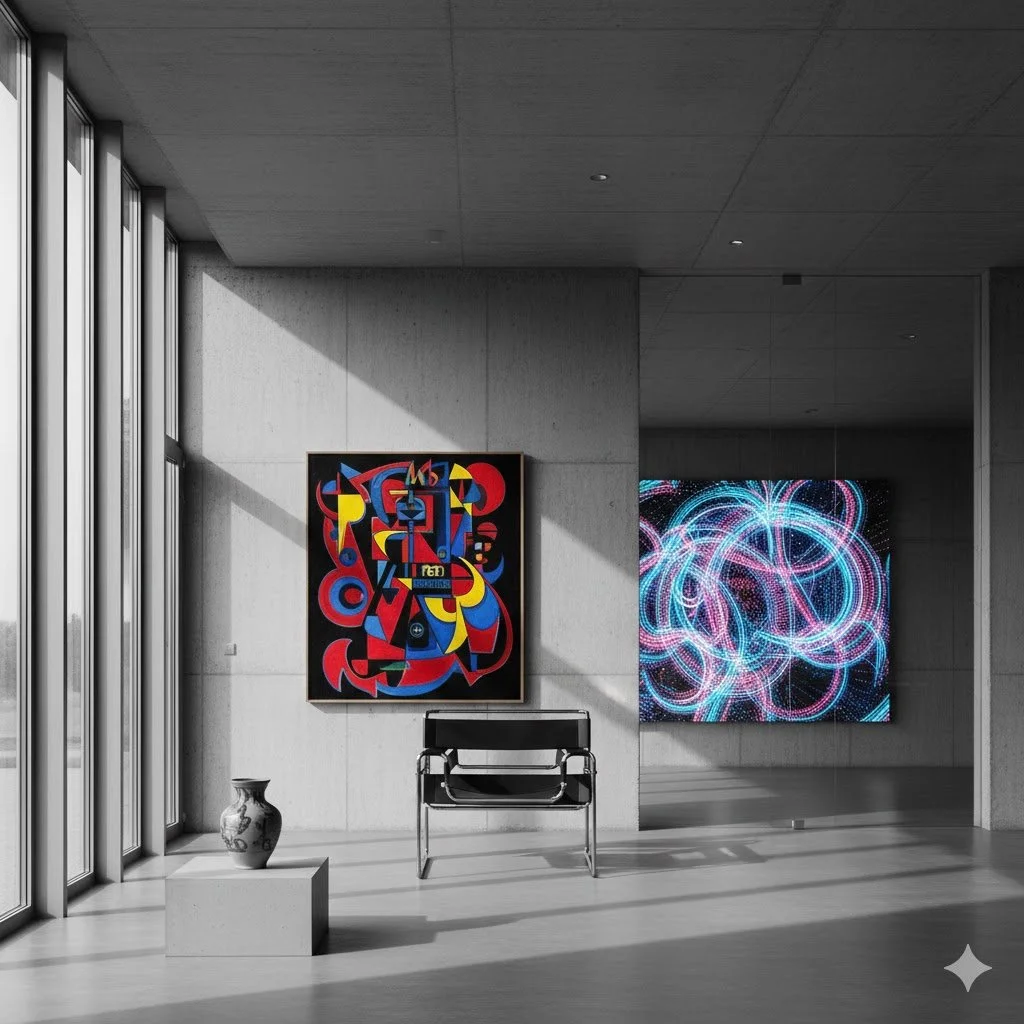
Olafur Eliasson’s installation Life at the Fondation Beyeler stands as one of the most prominent manifestations of this "art through interrelation". By removing the glass facade, nature flooded the gallery space, forcing the visitor into an immediate, physical relationship with the elements - a state of "being moved" (Ergriffenwerden) that lies at the heart of Rosa’s resonance theory. Parallel to this, Refik Anadol’s Living Archives transform static spaces into dynamic data ecosystems. His immersive projections utilize architecture as a membrane for digital natural processes.
Refik Anadol
While Refik Anadol transforms the new BRUSK in Bruges into a pulsating data ecosystem, Olafur Eliasson’s exhibition “Presence” in the Queensland Art Gallery | Gallery of Modern Art currently challenges physical perception as an active part of the architectural space.
Resonance Chamber
A "resonant" art collection is alive when it does not merely house objects, but establishes relationships; when it does not just store value, but expresses a stance. Then it becomes far more than the sum of its parts: a resonance chamber for the mind. From this understanding, THE STUDIO deliberately dedicates itself to architecture and design in interplay with art. For it is only within space that resonance is born.
AUTHOR
Victor Justus Messerschmidt
WORKS MENTIONED
The Artwork of the Future (Richard Wagner); Triadic Ballet (Oskar Schlemmer); Mechanical Ballet (Kurt Schmidt); The Soldier's Tale (Igor Stravinsky); Reflected Light Compositions (Ludwig Hirschfeld-Mack); Carré d’Art, Nîmes (Norman Foster); Sainsbury Centre for Visual Arts (Norman Foster); Pirelli Tower (Gio Ponti); Life (Olafur Elisasson); Living Archives & Presence (Refik Anadol); Resonance: A Sociology of Our Relationship to the World (Hartmut Rosa).
PERSONS MENTIONED
David Epstein; Friedrich Schlegel; Richard Wagner; Wassily Kandinsky; Pieter Oud; Oskar Schlemmer; Kurt Schmidt; Hermann Scherchen; Igor Stravinsky; Ludwig Hirschfeld-Mack; Norman Foster; Gio Ponti; Olafur Eliasson, Refik Anadol; Hartmut Rosa.
Visuals created with Google Gemini.
