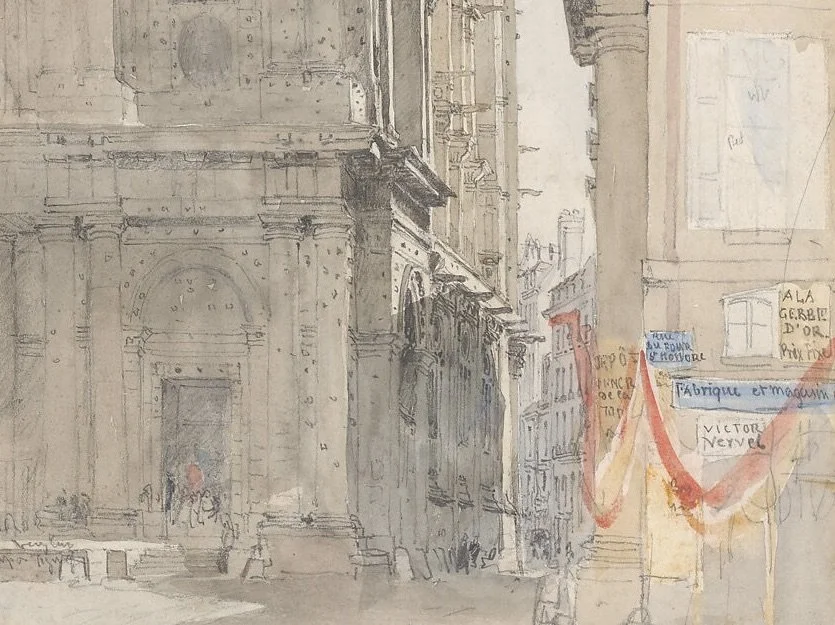
St. Eustache, Paris, David Cox, 1829, The Metropolitan Museum of Art, New York
“Amélie still likes to cultivate a taste for small pleasures.” (Jeunet, J.-P., Le Fabuleux Destin d’Amélie Poulain, 2001)
During Art Basel Paris week in October 2026, three Paris auction houses offerer three collections whose stories are worth more than their estimates. Sotheby’s sells the Schlumberger Collection, Christie’s the works kept for a century by the family of the dealer Paul Durand-Ruel, and Phillips a group of works from the collection of Marcel Brient.
Each of these collections was built against the taste of its time. And each, sooner or later, faces the question every collector eventually meets: what happens to a collection when it passes from one generation to the next?
This piece looks at the three collections through that question.
Two Women and the Late Monet
The Schlumberger name stands for an industrial dynasty: in 1926, the brothers Marcel and Conrad Schlumberger founded the company that became today’s oilfield services group SLB. The collection, however, is the story of two women (Sotheby’s).
In the 1950s, Marcel’s wife Jeanne met the Paris dealer Katia Granoff. At the time, Monet’s late work was widely regarded as unsaleable; even his own family called the vast late canvases the paintings of a blind man (Galerie Larock-Granoff). Granoff had won the trust of Monet’s son Michel, who had inherited the estate. In 1958, Jeanne Schlumberger financed Granoff’s purchase of works from Michel Monet’s studio, and the two women divided the paintings between them (Finestre sull’Arte).
Almost seventy years of silence followed. Jeanne Schlumberger never lent a painting to an exhibition, and the works hung in the family’s town house on Rue Las Cases until they came to auction. Iris, painted in Giverny around 1924–25, measures roughly 160 by 180 centimetres; according to Sotheby’s, it is the only work of this scale from Monet’s final decade still outside a museum (Sotheby’s).
The collection’s value therefore rests on three decisions made long ago: buying what others rejected, financing a dealer instead of competing with her, and keeping the works out of sight. The last of these turned the paintings into what the market calls “fresh to market”, one of the strongest price drivers there is.
A Dealer’s Family
Paul Durand-Ruel is often called the man who invented the market for Impressionism… He bought Monet, Renoir, Pissarro and Sisley when hardly anyone else would, paid some of them a regular income, and brought himself close to bankruptcy more than once (Barnebys). Monet later said, in essence, that without Durand the Impressionists would have starved.
A dealer usually sells what he buys. Yet part of Durand-Ruel’s holdings never left the family: 62 works remained with his descendants for more than a century after his death in 1922 and came to auction at Christie’s for the first time, with an overall estimate of 30 to 43 million euros (The Art Newspaper France). Among them is Trois pots de tulipes of 1885, one of 36 canvases Monet painted as door panels for Durand-Ruel’s Paris apartment (Christie’s).
The case shows how blurred the line between stock and collection can be. Works that once decorated a dealer’s home became family heritage, held together by his heirs for a century. That a family keeps a group of this size intact for so long is rare.
A Collector’s Eye
Marcel Brient’s story begins far from any salon. Born in 1940, the son of a stonemason on Île-Grande in Brittany, he trained as an engineer in metrology, the science of precise measurement.
Brient became one of France’s most important collectors of contemporary art. He recognised Jeff Koons, Ai Weiwei, Takashi Murakami and Felix Gonzalez-Torres. By the age of eighty, his collection counted more than 2,000 works, part of it installed in an 1,800-square-metre space in Saint-Ouen.
In autumn 2026, works from his collection appeared in several sales at once: Gerhard Richter’s Mathis led Phillips’ evening sale in London, and Joan Miró’s Peinture of 1930 headed Phillips’ first Paris sale of modern and contemporary art, estimated at 350,000 to 550,000 euros (Phillips). A collection of this size is rarely passed on whole. Releasing it in stages, across cities and sales, is one way of giving it a deliberate afterlife.
The Protagonists
Jeanne Schlumberger (1889–1983). An engineer’s daughter, married to Marcel Schlumberger from 1909. Among the first Frenchwomen to hold a driving licence, she avoided Paris society and was rarely photographed. Her brother-in-law Jean Schlumberger co-founded the Nouvelle Revue Française, the house that first turned down Proust; a fitting link for a sale titled after the final volume of his novel, Le Temps retrouvé (Sotheby’s).
Katia Granoff (1895–1989). Born in Mykolaiv, Ukraine, she came to Paris penniless in 1924, opened her first gallery in 1926 and moved to the Quai de Conti in 1931. She championed Monet’s water lilies when they were considered unsaleable, later opened galleries in Cannes and Honfleur, and published poetry and an anthology of Russian verse. Her gallery continues today as Larock-Granoff (Universalis).
Paul Durand-Ruel (1831–1922). Took over his parents’ art business in 1865 and met Monet and Pissarro in London during the Franco-Prussian War of 1870–71. With galleries and exhibitions in London, New York and Berlin, he laid foundations of the international art trade (Barnebys).
Marcel Brient (b. 1940). Stonemason’s son from Île-Grande in Brittany, engineer in metrology, collector of more than 2,000 works. His life is the subject of Thierry Compain’s 2017 documentary Un collectionneur à l’œuvre (KuB).
Glossary
Primary market
First sale of a work, usually through the gallery that represents the artist
Secondary market
Any resale, through auction houses or dealers
Single-owner sale
An auction devoted entirely to one collection, such as Schlumberger or Durand-Ruel
Estimate
The price range an auction house expects in advance; no guarantee
Hammer price
The price at which the lot is knocked down, before the buyer’s premium
Buyer’s premium
Fee paid by the buyer to the auction house on top of the hammer price
Provenance
The documented ownership history of a work; underpins both value and legal certainty
Fresh to market
A work that has been off the market, or never offered, for a long time; often a price driver
Catalogue raisonné
The scholarly complete catalogue of an artist’s work; central to questions of authenticity
Great Wealth Transfer
The large-scale transfer of private wealth to the next generation, including art
Sources
• Le Temps Retrouvé: The Schlumberger Collection, Sotheby’s
• Claude Monet, Iris, lot page, Sotheby’s
• Sotheby’s Paris: Die Schlumberger-Sammlung wird versteigert, Finestre sull’Arte
• À propos – Katia Granoff, Galerie Larock-Granoff
• Katia Granoff (1895–1989), Encyclopædia Universalis
• La collection Durand-Ruel chez Christie’s, The Art Newspaper France, 18 October 2026
• Bord des falaises à Pourville from the Durand-Ruel collection, Christie’s
• The Collection of the “Godfather of Impressionism” at Christie’s, Barnebys, 13 October 2026
• Phillips celebrates Modern & Contemporary Art across Europe this October, Phillips, 10 September 2026
• Bettina Wohlfarth, “Auktionen: Spektakuläre Werke von Monet bei Christie’s und Sotheby’s in Paris”, FAZ, 19 October 2026
